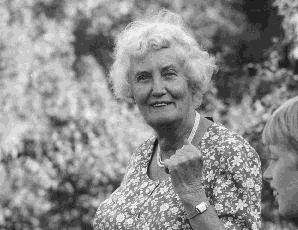
Af Gudrun Nissen, Klampenborg, February 1971
Looking at a map af Denmark you hardly realize that it contains 409 islands, only 108 of which are inhabitated. You see JUTLAND, the mainland, and the two big islands FUNEN and SEALAND, and southeast af Funen you find a narrow, nearly vertical island which is very appropriately called LANGELAND. Here the soil is good, and the landscape hilly; the Ahlefeldt counts live in state on Tranekær castle, and there are several other spectacular country seats. In the sixties a bridge was built from Funen to Langeland, and several ferries connect it with other islands. The only town RUDKØBING has not changed much during the last 100 years and mainly consists of one long street coming down to the harbour.
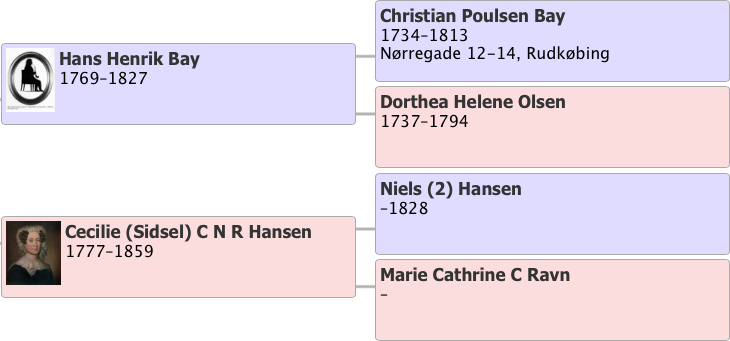
One af the more spectacular buildings in Rudkøbing is still the Bay house built in 1782 by
| CHRISTIAN POULSEN BAY (1734-1813) | |
| married to | DORTHEA HELENE OLSEN (1737-1794) |
| His father | MORTEN ANDERSEN BAY (1693-1770) |
| married to | ANNA MARGRETHE CHRISTIANSDATTER (1692-1788) |
probably started his business in Rudkøbing, where he owned a house and traded in corn and groceries. His son added a distillery and became one of the important businessmen of the town. The family became close friends of the chemists whose name was ØRSTED. The elder Ørsteds son Christian was to become the famous inventor of electromagnetism (or rather he found the principle), and the younger, Dorthea Bay’s godson, later became a renowned professor of law.
Last summer I visited the Bay house. It is now the premises of the local newspaper, Langelands Folkeblad, and badly spoilt by later owners’ vandalism. Still it contains spacious and well proportioned rooms in the one storey and pediment of which it consists. The Bays owned several ships and vessels for the transportation of their goods to the other islands and to the German ports. Behind the house are the remnants of a vast garden sloping down to the woods.
Christian and Dorthea were survived by one daughter and three sons. The younger son ERICH BAY (1778-1838) built himself another spectacular half-timbered house which still stands. The elder brother
| HANS HENRIK BAY (1769-1827) | |
| married to | CECILIE CHRISTINE HANSEN (1777-1859) |

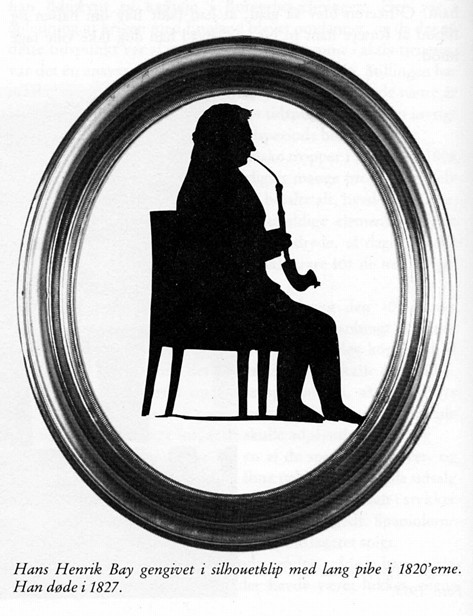
took over the family business, and his ships went as far as England. At first all went well, it was the years af great agricultural reforms, and besides having their large, well-stored shop the Bays traded corn and transported it in their own vessels. Hans Henrik Bay was a handsome man who loved a good life and who was succesful as long as nothing went wrong. But at the end af the Napoleonic wars he speculated in corn and was ruined in the State Bankruptcy 1814, and after that he became lethargic and odd.
Eleven children grew up in the family house, eight of them boys. Every boy in Rudkøbing knows how to handle a boat, and I am sure that the Bay boys spent most of their leisure time in the harbour watching the coming and going of the boats or giving a hand on their father’s vessels. However, only two became sailors and shipowners. Three became merchants in Rudkøbing, one a very prosperous mill-owner in LOLLAND, and the youngest a clergyman.
When their father became ill, their mother CECILIE took over. She was a woman who had both energy and intuition, and each of her sons named a daughter after her. She kept the business going until her eldest son could take over, but it was a struggle. She became notorious for ordering the biggest copper kettle ever seen – it contained a pail of water. On the weekly market day it would hang in the open fireplace filled with coffee (one pound of coffee and one pound of chicory) giving away a delicious smell which drew the farmers and fishermen and their wives into the shop. Everyone had a cup of coffee sweetened with sugar-candy (then a luxury), and a good confidential talk. And when the farmers had their purchase brought to their carriage they would find a hot stone to put under their feet, so they came home not feeling the cold.
Even with all those children of her own Cecilie did not hesitate to bring up her sister’s children when they became orphans. Her nephew MADS LANGE (1807-56) was a special friend of THEODOR, her number four boy (great-grandfather to Jens, Leila, Billie and Axel). Theodor Bay has always been spoken of as a wild boy, but Mads Lange cannot have been much behind. Very little is known of how and when they went to sea, but they must have started young, first on the family vessels, later as officers on foreign ships. I have not been able to trace their wanderings, nor how long they sailed together. But Mads ended up in Bali.
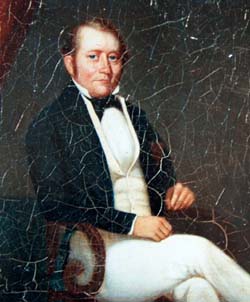
He was kind of engaged to Theodor’s younger sister IDA (1818-1887), and for several years he wrote to her and begged her to come out to him as he owned land and plantations in a wonderful climate. Her mother urged her to go, but the girl, who took after her father, became troubled and despondent when decisions had to be made. She never married, and I have been told that the many costly presents Mads sent her were put away. A spinster could not accept gifts from a man. In the end he married a sultan’s daughter, and he called their only child CECILIE.
It is my personal and private theory that at a time both he and Theodor were slave traders. They both earned a fortune very young. In the old ship registers in the Kronborg Naval Museum at Elsinore I have found Theodor Bay registered as the owner of a schooner only, and therefore I am sure that he has owned – or commanded – ships in other (probably British) countries. He was always called CAPTAIN BAY.
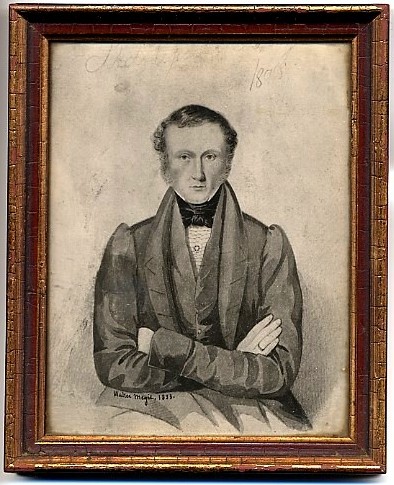
In 1833 he was in London where he was presented with a crystal glass cup as a mark of honour (?). I own this precious heirloom. It is doubtless rococo, beautifully engraved and provided with a crown on the lid, but the letters engraved, AMDFC, cannot have to do with Theodor Bay. He also brought back a small portrait of himself done in pencil, and four plate silver candlesticks. The same year he acquired a large farm about 10 miles from AARHUS, LUDVIGSHOLM near Harlev which still stands as it was.
And he married
MARIE MAGDALENE ELISABETH BRØCHNER (1813-49)
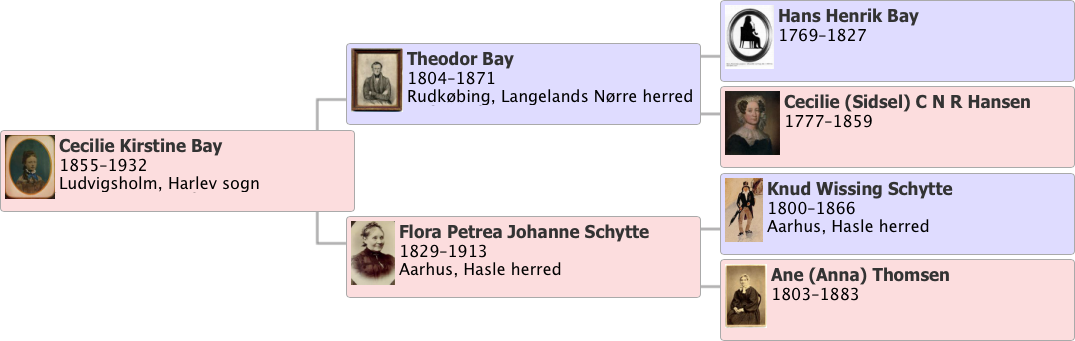
a cousin of the philosopher SØREN KIRKEGAARD. Unfortunately she had the same melancholic turn of mind. Theodor was a very handsome man, notorious for “wildness”. My grandmother (his daughter Cecilie) said that a book had been written about him, called “The Escapades of Theodor Bay”. He was never good at being the virtuous landowner.
He did not make Elisabeth happy, and it was said that each time she had a child he had made one of the milk-maids in the way of being its wet-nurse. There was a mill on the farm, and the gardens form practically an island in the Aarhus river – not a very good site if you a inclined to what was then called a “weak chest”. She may have died of tuberculosis (at 36), but a rumour says that she drowned herself in the garden stream. Later, four of her six children died of TB.
I know nothing about his widowhood, but in 1854 he engaged Miss
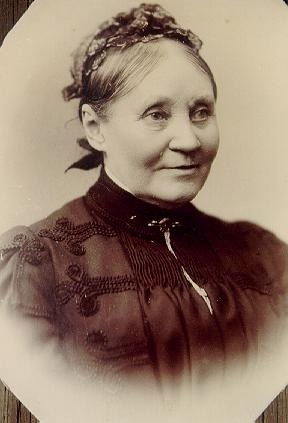
FLORA PETREA JOHANNE SCHYTTE (1829-1913)
as a governess for his children. One of the six or eight surviving children of Knud Wissing Schytte, clerk of the cathedral of Aarhus, a vivacious and musical family, she would have liked to become on actress, but then she was wind-eyed. She won the hearts of her pupils by making them play comedies instead of trying to be severe. And in no time she was married to the Captain, and CECILIE was born October 1855. Flora had to endure much, in 1858 and 1862 three of her stepchildren died ( I have a photograph of THØGA taken shortly before her death at 18, a beautiful girl) – and at the same time her two first boys died. Perhaps it was she who made Theodor sell “Ludvigsholm” and “Harlev Møllegaard” (as is its actual name) 1862. They looked for something nearer Aarhus and very nearly bought Jægergaarden, but Flora vetoed against it as the grounds went down near the harbour and she disliked the smell of seaweed. A pity since a great part of Aarhus was shortly to be built on its grounds. So they bought a town house behind the Cathedral. During the war 1864 he gambled in corn ond lost most of his fortune, like his father had done. As my grandmother recollected him, he was soured and disappointed.

So Flora became a widow at 42, Cecilie was 16,
JENS PILEGAARD BAY (1857-1902)
was 14 and young Henrik 9. The boys went early to sea, and at 19 Henrik died of yellow fever in the Indian Ocean. PILEGAARD, as your grandfather was called, sailed the Great Seas for many years, and always brought home lavish and exotic presents for his mother and sister and later for her children who loved him. Later he entered DFDS (The United Steamship Companies) and eventually became first officer and captain on their Russian and Baltic lines. In the eighties he was a mate on the first Danish-American Line, the Thingvalla Line, and there he was involved in the most phantastic collision when two Thingvalla ships collided head-on in the Atlantic Ocean. He was lying on his bunk when suddenly he saw the stern of the other ship penetrating the wall of his cabin, and he managed to climb to safety on the other ship. That is at least what my grandmother said. It was a terrible disaster, much talked of at the time, and many perished.
Pilegaard was a batchelor for many years. Then one day a highly elegant lady, a former maid of honour to the Swedish queen, Miss Constance of Forselles, came on board his ship in Helsingfors. (I have her portrait, and she is not unlike Tante Inger). She asked him, as one did in those days, to take care of her young niece, Miss Karin Ullner, during the passage to Copenhagen.
KARIN ULLNER was an orphan – her father had been an engineer in the oil-fields of Baku – and she was being educated with her sister by her aunt, who sent them to English and French schools. “Uncle Pile” took care of her so well that they soon after married and settled in the small town of NAKSKOV on the island of Lolland. Though the very prosperous Bay family (page 2) lived in Nakskov, Karin cared little for the provincial life. They had a daughter, VALBORG, 1898, and then
HENRIK VlLHELM THEODOR BAY (1899-1962)
was born. The family moved to Copenhagen, where the twins, ELLEN and INGER were born, but only Inger survived.
When Inger was hardly two, Pilegaard died of pneumonia, then a deadly disease. Karin was not pleased with Denmark. She thought her husband’s family, the two widows Flora and Cecilie, very dull, and besides there was not much money. A captain in the merchant navy was ill paid, and until her death her pension was 25 kroner a month! She was not prepared to live a modest life, so she collected whatever money she could find and her children and went off to Stockholm to train as a physiotherapeutist. “Swedish massage ” was the very newest and best, and she settled in Paris where she soon got a very exclusive clientele, notably amongst the actors and actresses of Theatre Francais. She was extremely intellectual and a great reader, and through her actor clients she met authors and other interesting people.
In Paris she brought up her three children. Poor Valle had a severe accident sledging and never was quite “right” after that, but she was dearly loved by her mother. Cecilie’s daughter, GERDA, spent a winter
with the family and liked them very much. Karin was no ordinary mother (she had seen enough of that in Denmark’). Once she dismissed a maid for preventing Henrik from hammering nails into the piano. When she earned money it was put in a cigar box, and so long as there was any she was pretty extravagant and did not care when it would be finished.
I met her for the first time in Paris in 1935 and found her a good-looking and interesting lady. In ’39 I saw her again, and she looked even better, young and elegant. I think you all remember her.
This has brought us far away from Theodor, but I know no more.
Of Flora’s family I can tell that her great-grandmother
ANE CLARA SPENDRUP (ca. 1752-80)
was a sister of the great poet JOHANNES EWALD’s friend Peder Spentrup. In the small literary museum “Bakkehuset” in Copenhagen you can see the poet’s pocket-book embroidered on white morocco, sewn by Ane Clara.
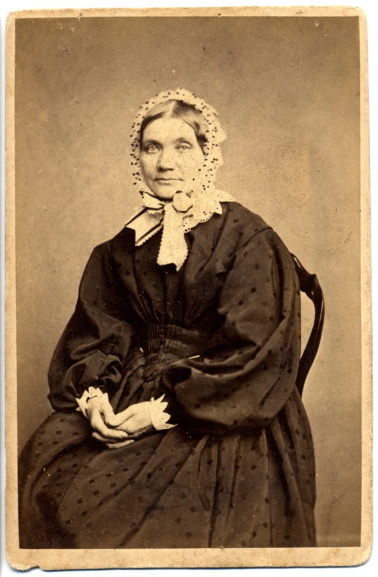
Flora’s mother, Ane Thomsen (1804-89) was a keen card-player, and so was Flora. She was found dead in her bed one morning when she was over 84, when she had played cards the night before. Ane’s husband, KNUD SCHYTTE, had begun his studies to become a clergyman but fell in love with Ane so violently that he gave up his studies and settled down as a modest clerk. Their house is still the clerk’s office. He wrote poetry – I have a hand-written collection – and he has also written an excellent description of Aarhus Cathedral, the longest church in Scandinavia. His children called him “The Altar Devil”, his title being “Alter-Degn” – but remember he had so many. His youngest son wanted to be a pianist and eventually became a renowned composer, but not a great pianist as he was not allowed to study but had to work as a chemist’s apprentice for four years. His name was Ludvig Schytte. His daughter Anna became a great pianist, but at 50 she got rhumatism in her fingers, and she had a sad old age, scraping money together to leave a legacy bearing her father’s name.